Physicochemical Properties of Bare Metallic Clusters and Ligand Protected Metal Clusters
Chirality in Protected Clusters
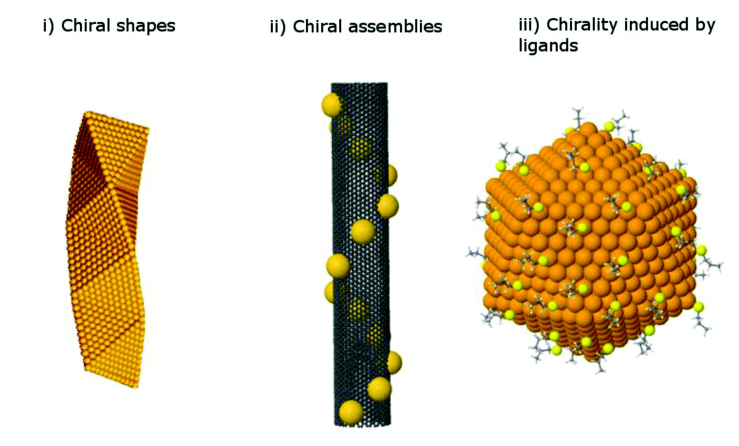
Chirality is a fundamental property of matter with profound impact in physics, chemistry, biology, and medicine. It is present at several scales going from elementary particles to molecules to macroscopic materials, and even to astronomical objects. During the last 30 years chirality has also been investigated at the nanoscale, being a hot research topic in nanoscience. The importance of chirality at the nanoscale is due, in part, to the potential applications that chiral nanomaterials could have in nanotechnology. Great interest exists nowadays in the study of chirality in bare and ligand-protected metal nanoclusters. These are aggregates of n metal atoms (n ~ 10-300) that can be in gas phase or stabilized by organic ligands, covering the cluster surface. Chirality in bare and thiolate-protected gold clusters (LPGC) has received special attention because the important progress achieved in their synthesis, size-separation, and precise structural characterization. Here, we review the recent experimental and theoretical developments on the origin and physicochemical manifestations of chirality in bare and LPGC. Since chirality is a geometrical property, we also discuss the proposal for its quantification, and the correlation of this geometric measure with the chiroptical response like the circular dichroism spectrum, calculated from quantum-mechanical methods.